
I know what you’re thinking. How is art supposed to help to refugees on Lesvos?
Well, there’s something called creative arts therapy which involves the use of creative techniques such as visual art, drama, dance and music to help participants express themselves artistically and to examine their psychological and emotional undertones through their art (Spiegel, et al. 160).
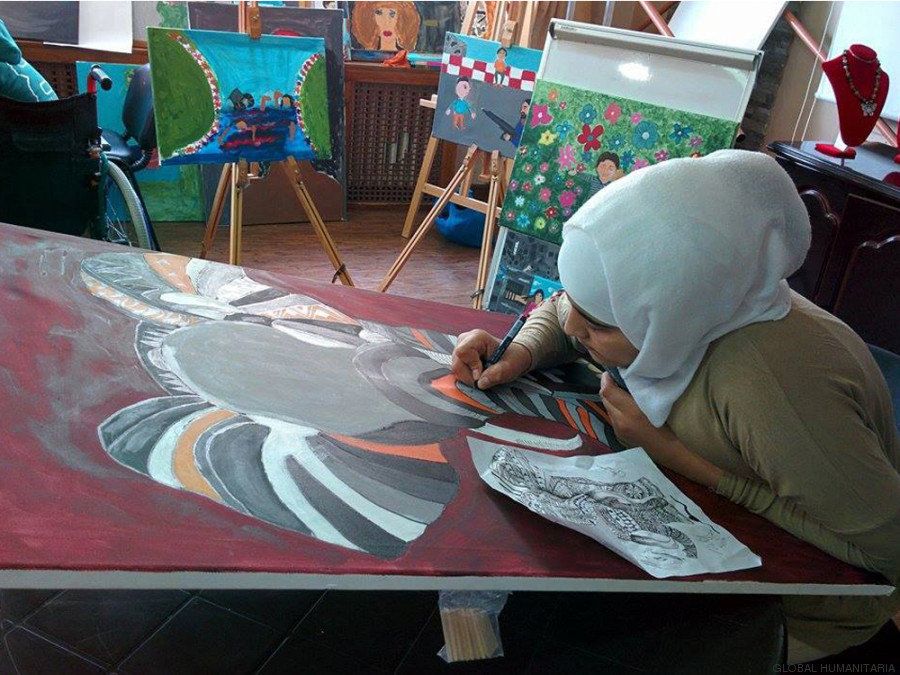
Creative arts therapy is unique to other traditional mental health treatments because it presents fewer cultural and linguistic barriers to clients’ therapeutic success because of how it relies on little spoken communication and encourages free expression (Rowe, et al. 27). While these techniques still depend on interpreters or Syrian volunteers to deliver instructions, art therapy allows participants to explore their memories and emotions subtly, providing a safe space to resolve overwhelming traumatic symptoms and focus on positivity and growth.
Moreover, according to an article in the Behavioral Sciences Journal, art therapy can help to ease one of the most frequently overlooked psychosocial problems of refugees—homesickness. According to various clinical studies, creative art therapy—with its attention to preverbal language through music, imagery, dance, theater, and movement—is able to reach individuals through the senses and promote successive integration, which can lead to transformation and therapeutic change. These forms of therapy can be a temporary home for refugees in the assimilation process, by serving as a safe transitional space (Dieterich-Hartwell, 2). Finally, creative art therapy is a more approachable non-medicinal method of treatment that mitigates much of the mental health stigma associated with more traditional mental health treatments (McAlevey).
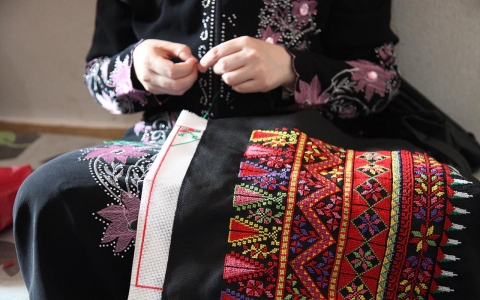
Anyway, my first task upon arrival in Lesvos will involve starting an embroidery program for both refugee and Greek women. Not only will this be a type of art therapy, but it will hopefully create a safe and welcoming space for refugees to interact with the local community and vice-versa. Despite not having any embroidery experience whatsoever, I am so very excited to contribute to this program and can’t wait to get started!
If you’re interested in learning more about specific techniques and outcomes of creative arts therapies, here are a few interesting case studies involving Syrian refugees integrating locally in Turkey:
- Gurle NS. Enhancing the awareness of emotions through art and drama among crisis-affected Syrian refugee children in southeast Turkey. Intervention [serial online] 2018 [cited 2019 Apr 23];16:164-9 http://www.interventionjournal.org/text.asp?2018/16/2/164/237951
- Hakki B. Using art tools with older Syrian refugee women to explore activated development. Intervention [serial online] 2018 [cited 2019 Apr 23];16:187-94. http://www.interventionjournal.org/text.asp?2018/16/2/187/237955
- Nilay Ugurlu, Leyla Akca & Ceren Acarturk (2016) An art therapy intervention for symptoms of post-traumatic stress, depression and anxiety among Syrian refugee children, Vulnerable Children and Youth Studies, 11:2, 89-102,DOI: 10.1080/17450128.2016.1181288
Other sources:
- David Spiegel MD, Cathy Malchiodi MA, ATR-BC, Amy Backos MA, ATR-BC & Kate Collie PhD, MFA, ATR (2006) Art Therapy for Combat-Related PTSD: Recommendations for Research and Practice, Art Therapy, 23:4, 157-164, DOI: 10.1080/07421656.2006.10129335
- Rowe, C., Watson-Ormond, R., English, L., Rubesin, H., Marshall, A., Linton, K., … Eng, E. (2017). Evaluating Art Therapy to Heal the Effects of Trauma Among Refugee Youth: The Burma Art Therapy Program Evaluation. Health Promotion Practice, 18(1), 26–33. https://doi.org/10.1177/1524839915626413David Spiegel MD, Cathy Malchiodi MA, ATR-BC, Amy Backos MA, ATR-BC & Kate Collie PhD, MFA, ATR (2006) Art Therapy for Combat-Related PTSD: Recommendations for Research and Practice, Art Therapy, 23:4, 157-164, DOI: 10.1080/07421656.2006.10129335
- Dieterich-Hartwell, Rebekka, and Sabine C Koch. “Creative Arts Therapies as Temporary Home for Refugees: Insights from Literature and Practice.” Behavioral Sciences vol. 7,4 69. 17 Oct. 2017, doi:10.3390/bs7040069
 Inside IsraAID Greece
My heart is in the fiber arts. So excited to learn about this.
LikeLike